What is Zuckerberg’s Metaverse, and Do We Want It?

In a recent blog, I suggested that we have finally lost patience with Facebook after new revelations by whistleblower Frances Haugen and the Wall Street Journal. Leaked documents show that FB knows that almost six million VIPs are given special dispensation to violate their content standards; criminals use FB to recruit women, incite violence against ethnic minorities, and support government action against political dissent; Instagram is toxic to many young girls, contributing to poor self-image, mental health, and suicidal thoughts; the firm relaxed its safeguards too soon after the U.S. election, contributing to the January 6 riot; and FB is incapable of suppressing election and vaccine misinformation. 

Read More »

Stretched Too Thin by Social Media: Beware its power to reshape your web of relationships 

Brett Frischmann is the Charles Widger Endowed University Professor in Law, Business and Economics, Villanova University. His most relevant book to his thoughts below is Re-Engineering Humanity (Cambridge University Press 2018).

This post is based on an article that appeared in Scientific American (January 2020).

Recently, I’ve received multiple invitations to leave Facebook and Twitter and join a new social network that promises to not destroy democracy. I’m tempted. I’m also tempted to delete my accounts and abandon social media altogether. The decision got me thinking, not about democracy but instead about how social media affect my behavior and relationships. 

Social media promise and deliver social networks with better or at least bigger scale and scope. Essentially, this means you can connect to many more people from many different places to relate on a wider variety of interests. To socialize is a core human need. The difficult question is whether social media improve our capability to relate to each other. 

Read More »

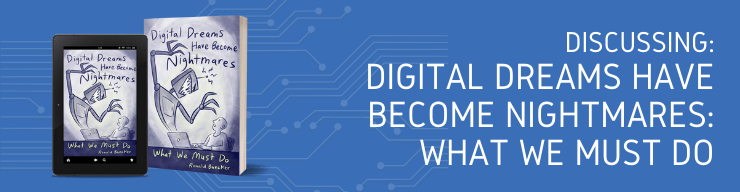
A Review of: ‘Digital Dreams Have Become Nightmares: What We Must Do’

C. Dianne Martin is Emeritus Professor of Computer Science at George Washington University, and Adjunct Professor in the School of Information, University of North Carolina at Chapel Hill. She has been teaching Computers and Society since 1983.

I was delighted to receive email early this year from Prof. Ron Baecker, whose Computers and Society class at the University of Maryland in 1972 made me see that I could productively combine my previous studies in the social sciences and humanities with my new career in information technology. I was therefore eager to read his latest book, Digital Dreams Have Become Nightmares: What We Must Do.

In documenting his personal journey from dreams and exuberant optimism about computer technology to pessimism, nightmares, and fear caused by the emerging consequences of the tech explosion of the past 75 years. Ron has provided a comprehensive historical sweep of the computer revolution. In Part I he chronicles the high hopes of early developers to create technological solutions to disparities in healthcare and education, to increase creativity, collaboration, and community, and to provide greater power and convenience to all.

Read More »

Technology and lifestyle in the COVID 4th wave and beyond

My blog post of May 18 suggested that some of the COVID-forced changes in work will survive past-COVID: “Large companies will shrink their office space footprint. Landlords will suffer economically, spaces will be vacant, and prices will drop. Many employees will work at home far more frequently than they did pre-pandemic. Many employees will no longer have a permanent desk; rather, they will grab a free desk when they are in the office. There will be less business travel, with more business conducted via teleconference. Progressive conferences will allow for both on-site and virtual attendance. Reductions in travel by [land and air will help] the environment.” 

Read More »

Chilling New Technologies for Surveillance

Technologists are creating increasingly more sophisticated digital technologies capable of monitoring us. 

The most mature technology is that of RFID tags. Now as small as grains of rice, RFID tags typically track the location and movement of items through an assembly line, warehouse, store, or library. The tags can also be attached to personal possessions such as clothing, passports, or cash.  RFID tags can be and are implanted in animals in order to track them in the wild. This is not now done to humans, although people may be carrying items with RFIDs and be tracked without realizing it. 

Other location tracking uses the Global Positioning System (GPS) of satellites. It allows mobile devices to know where on earth they are located, and also allows location tracking on those devices, and hence to monitor the whereabouts of a person carrying the phone. A chilling example of this occurred in a political protest in Ukraine in January 2014, when individuals who were in the barricaded city centre of Kiev received text messages saying ‘Dear subscriber, you are registered as a participant in a mass disturbance’. 

Read More »

Working at home during and after COVID

My blog post of February 11 shared the account of four people who, despite COVID, have preserved and in some cases enhanced family connections and communication through the use of teleconferencing technologies. This essay will look at the present and future of distance collaboration for work. 

It has not been easy, especially for couples who both have jobs and who have school-age children at home. There have been severe stresses in maintaining concentration and balancing work time; periods helping children with schoolwork; and time for chores, exercise, play, and being alone. 

Read More »

COVID, Accessibility, and Aging-in-Place

Contributed by Margot McWhirter, MA, OT Reg. (Ont.) who is a Consultant on Inclusive Aging, Aging-in-Place, & Accessibility (www.inclusiveaging.com)

Margot, how long have you been an aging-in-place and accessibility consultant?  Please tell us in more detail what you do. I’ve been involved with aging-in-place and accessibility issues throughout my occupational therapy career – so, for over 25 years now. In 2019, I started consulting on a full-time basis. I make it possible for people to stay in their own home as their needs and abilities change by reducing the barriers that limit independence, health and safety. This includes working with people who are planning ahead for empowered, resilient aging. As well, I work with individuals and family caregivers who are facing unexpected challenges in daily routines and activities, due to medical or mobility issues – which can include COVID. Specifically, I assess, recommend and guide people through their options for home modifications, equipment, health care and community services. I also help bridge the gaps within and between disjointed systems, to enable clients to access resources and optimize their well-being at home.

Read More »

Physically separated, socially connected

Contributed by Ron Baecker, an Emeritus Professor of Computer Science at the University of Toronto, co-author of The COVID-19 Solutions Guide and author of Computers and Society: Modern Perspectives (OUP, 2019).

My family is widely separated. I live in Canada. My brother-in-law, niece, nephew, and their families are in New Jersey and Pennsylvania; my cousins, their children, and their families are in Argentina, Spain, England, and on both coasts of the USA. Typically, I visit my niece and nephew once or twice a year; I manage a trip to Buenos Aires or Bilbao, Spain, about every 3 years. But not recently. I therefore Facetime with either my nephew or my niece almost every week. We also are about to have our fourth global family Zoom. This started out to celebrate individual birthdays, with great spirit and feeling of bringing the family closer together. The next event will celebrate 3 birthdays — ages 78, 41, and 9 — and a recent birth in the family in London. The 9-year-old birthday event will see us participating in a day-long scavenger hunt. What fun!

Read More »

Senior Care Homes Aren’t Ready for the Second Wave

Contributed by Ron Baecker and Gary Feldman

Ron Baecker is an Emeritus Professor of Computer Science at the University of Toronto and author of Computers and Society: Modern Perspectives (OUP, 2019). Gary Feldman, MD, FAAP, FABMG, is a retired physician who was the Public Health Officer of Ventura County and Riverside County in California for 14 years. They are two of the co-authors of The COVID-19 Solutions Guide.

The COVID-19 Solutions Guide, published in mid-June, described the effects of the first wave of the virus on senior care in North America as follows:

As of early June, over one-third of the known COVID-19 deaths in the U.S. have been to residents and staff living and working in nursing and long-term care homes. As of early May, a shocking 82% of the known virus deaths in Canada have been to those in long-term care. A Canadian Forces report commissioned by the province on Ontario, released in late May, reported numerous incidents of poor infection control, residents being denied food or being fed improperly, residents being treated roughly, and staffing problems. A flurry of lawsuits is expected. In Ontario, a $50 million suit was filed on May 1, 2020, alleging that one of Canada’s largest operators of senior residences and long-term care facilities lacked “proper sanitation protocols and adequate testing to prevent the spread of COVID-19”. In the United States, nursing homes have sought emergency protection from lawsuits alleging improper care.”

Read More »

What’s New in the Second Edition of The COVID-19 Solutions Guide

Contributed by Ron Baecker, who is an Emeritus Professor of Computer Science at the University of Toronto, co-author of The COVID-19 Solutions Guide and author of Computers and Society: Modern Perspectives (OUP, 2019).

The Second Edition of The COVID-19 Solutions Guide will be published and available this Friday.

We had not anticipated writing a second edition so soon. Yet events this fall suggested that it was important that we do so. Our goal is to make current the story we tell about the pandemic, the problems it is causing, and the solutions we recommend. What we describe below has happened in part because of the unwise actions of politicians with little understanding or respect for science, and a willingness to sacrifice human life for political ends. Another cause has been the poor judgment of young people, whose natural desire for partying and close physical contact has contributed to a substantial extension of the first wave of the virus. Also, some clergy have placed their insistence on congregate worship above public health advice, adding to the viral spread.

Read More »